
Beyond the Classroom: The Digital Transformation of Association Bab Rayan and the Future of Moroccan Education

Mapping the Evolution of Moroccan Education System
Morocco is grappling with a structural challenge, as its educational system operates at two different speeds. Education has long been a national priority for Morocco, reflected in the country’s investment of 6.0% of its GDP in the sector as of 2023—well above the OECD average of 4.9%. This commitment has laid important foundations for progress, yet achieving equitable learning outcomes across all regions remains an ongoing challenge. The question today is not only how much is spent, but how consistently those resources translate into effective learning environments.
National assessments point to persistent disparities between urban and rural areas, particularly in teaching quality, infrastructure, and digital readiness. These gaps are especially visible in school retention: whilst over 90% of women aged 15-17 attend classes in urban areas, that figure is just 39% for rural Morocco .
Such differences illustrate the structural constraints that can limit the full impact of recent reforms, including the Strategic Vision for Reform 2015–2030.
Teacher training remains central to this challenge. While Law 51.17, adopted in 2019, set an ambitious target to recruit and train 200,000 teachers by 2030, the reform is still in its early stages, and its outcomes will take time to assess. Strengthening professional preparation and ongoing development will be key to ensuring that new investments translate into meaningful improvements in the classroom.
A Diaspora Initiative Steps In
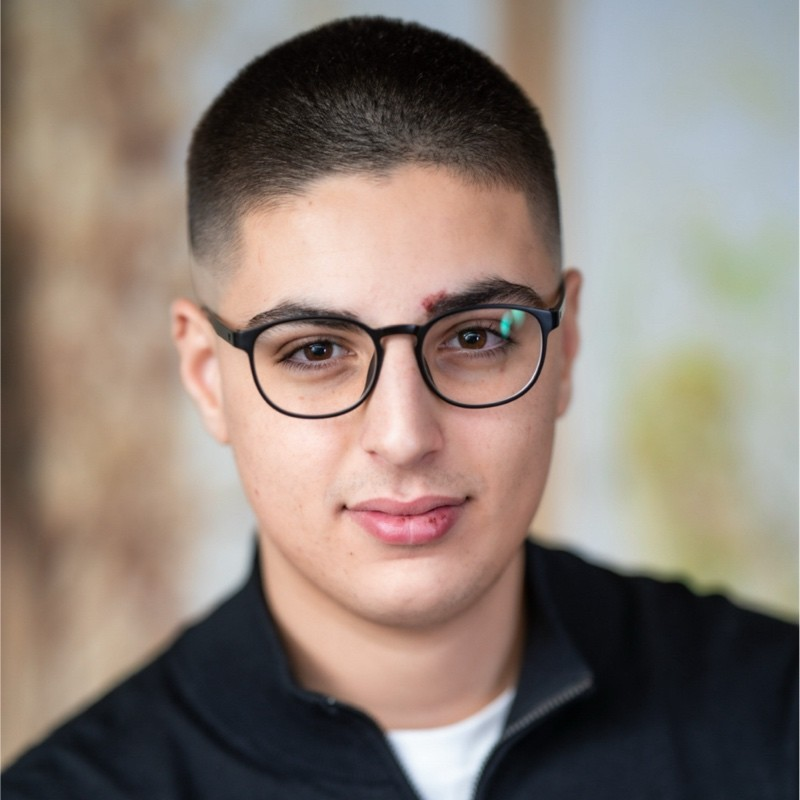
Against this national backdrop, my experience with Ta’leem Trust offers a small but illustrative example of how community-led efforts can bridge gaps on the ground. I have been in Casablanca for the last four months doing something that is very close to my heart: trying to increase the access to education for children with no access to it. I have set up Ta'leem Trust, an educational NGO, that I have registered in the UK as a charity. We assist disadvantaged Moroccan children in attaining a quality education. This endeavor aligns with the UN's 4th Sustainable Development Goal, which is to make education accessible and equitable to all.
As a Moroccan Jew, it is my privilege to contribute to the country my grandparents came from. There is a unique, historical explanation for this. During WWII, Vichy France was under the influence of the Nazis and the authorities pressured King Mohammed V to deport the Jewish population of Morocco. 250,000 of the country’s citizens would have been sent to concentration camps. The King refused. He famously stated, "There are no Jews in Morocco. There are only Moroccan subjects," and that declaration saved a quarter of a million lives.
Judaism teaches the value of Hakarat HaTov, or gratitude, a principle that calls for acknowledging goodness through both words and actions. Guided by this tradition, I felt compelled to give back to Morocco.
Before Ta'leem Trust, I had only visited Morocco as a tourist, mainly for Jewish pilgrimages to rural communities and family vacations. On those trips, I would often see children around the age of 10 selling fruits on the sides of the street, and I wondered why they weren’t in school. That’s when I realised I needed to be involved in a Moroccan project relating to education.
Inside Ta'leem Trust’s Classroom Impact
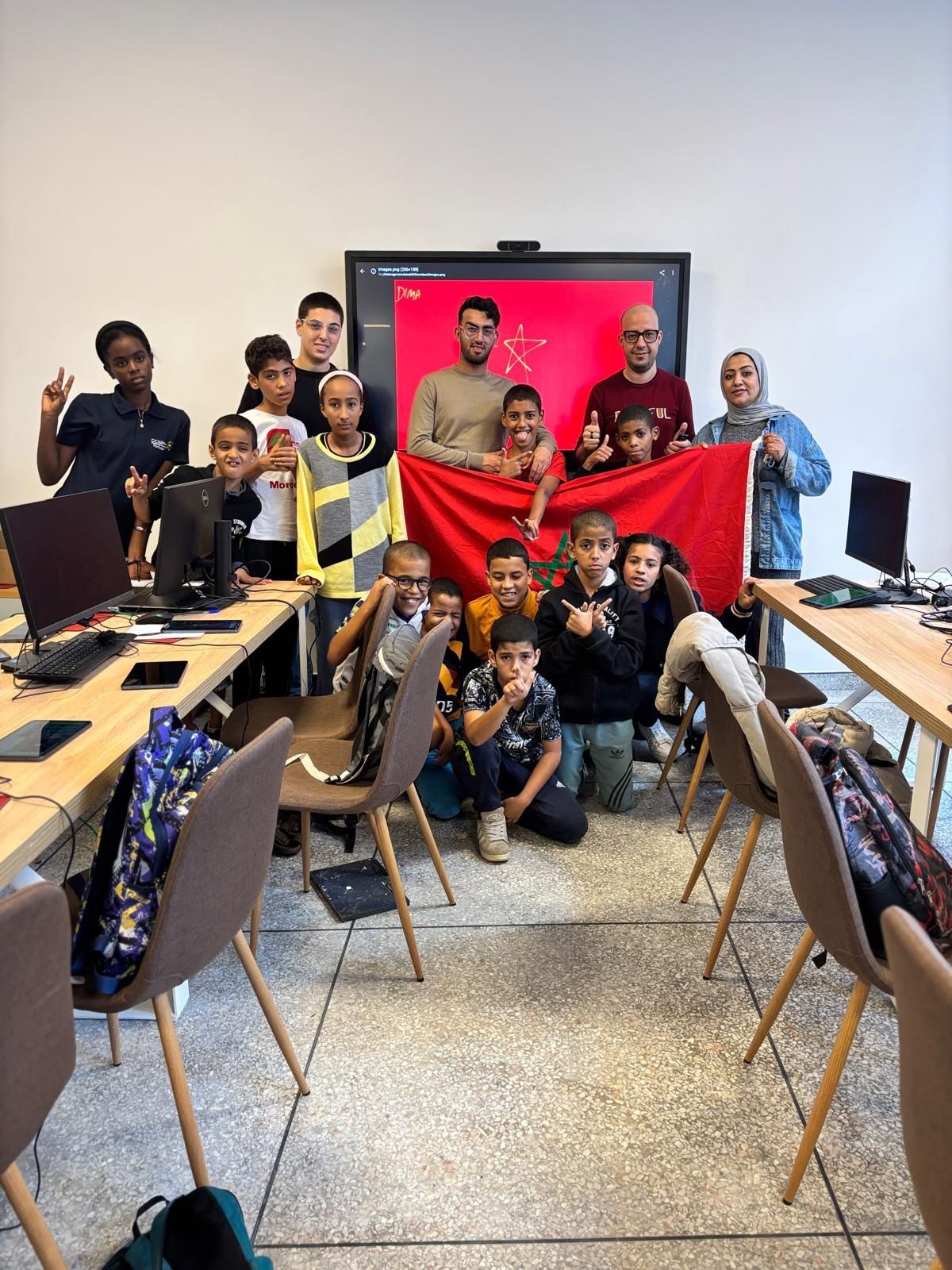
Ta’leem Trust has two main goals: raising money to donate school supplies and providing actual teaching. I collaborated with Association Bab Rayan, an orphanage school in Casablanca. During the period September to December 2024, I taught Maths, English, and French to students aged 9 to 13 and Financial Literacy courses aimed at 15 to 18-year-olds.
Seeing the difficulties for student engagement in a lesson with just a whiteboard and marker, I decided to allocate the fundraising resources to digital resources. I managed to fundraise over 11,000 dollars by contacting the Moroccan diaspora and the Moroccan-Jewish communities. This sum of money made it possible for us to purchase over 30 iPads and desktop computers for Bab Rayan, for the advancement of their digital learning environment.
Despite having now completed my teaching project in Casablanca, Ta’leem Trust does not end here. Through a new partnership with the Beth Habad of Morocco, we plan to support additional education initiatives for Moroccan children and encourage Moroccan-Jewish youth to volunteer regularly at the orphanage.
Pathways Forward to Morocco’s Education System
One promising solution is to widen professional learning opportunities through international collaboration. An annual pedagogical exchange conference in Rabat, Casablanca, and Marrakech could bring Moroccan teachers together with peers from Europe and North America. Teacher collaboration is one of the most effective ways to advance pedagogy and its diffusion, and this is particularly true for cross-border collaboration in teaching (Hattie, 2012). Such collaboration would directly support the goals of Law 51.17 by expanding access to high-quality, ongoing teacher development.
Another solution lies in tapping more strategically into Morocco’s global diaspora, which has already shown its potential to address gaps in technology, training, and school resources. Ta'leem Trust demonstrates what’s possible in this area. Structured programs could channel Moroccan talent in teaching, technology, finance, and school management. This could take several forms:
- A Diaspora Education Partnership Platform under the Ministry of National Education
- Targeted grants for diaspora-backed digital transformation projects
- Incentives for diaspora teachers to offer short-term training in public schools
A further challenge is ensuring that digital transformation truly improves learning. This requires investing not just in devices but in digital pedagogy training that enables teachers to integrate technology meaningfully into lessons and assessments. There must be additional training for teachers that focuses on the proper implementation of technology in their lesson design, formative assessment, and differentiated instruction. Incorporating digital pedagogy training into pedagogical institutes and offering in-service training that focuses on the digitally transformed goals of the 2015-2030 Vision are steps that Morocco can take.
What I experienced at Bab Rayan is a further manifestation of a broader national trend: the relationship between state policy and community-led efforts. Ta’leem Trust intends to continue expanding its efforts, and under the leadership of His Majesty King Mohammed VI, the vision for a more equitable and opportunity-rich education system is becoming increasingly attainable.
Bibliography:
CSEFRS (2019) Rapport sur l’éducation inclusive au Maroc. Conseil Supérieur de l’Éducation, de la Formation et de la Recherche Scientifique. Available at : https://www.csefrs.ma/wp-content/uploads/2019/05/Rapport-e%CC%81ducation-inclusive-Fr.pdf(Accessed: 6 December 2025).
Hattie, J. (2012) Visible Learning for Teachers: Maximizing Impact on Learning. Routledge.Morocco World News (2020) ‘Remembering King Mohammed V: Morocco’s revolutionary monarch’.Morocco World News, 19 May. Available at : https://www.moroccoworldnews.com/2020/05/70190/remembering-king-mohammed-v-moroccos-revolutionary-monarch/(Accessed: 8 December 2025).
Morocco World News (2021) ‘Access to education for rural Moroccan girls jumps 34 points in 20 years’.Morocco World News, 18 October. Available at : https://www.moroccoworldnews.com/2021/10/53906/access-to-education-for-rural-moroccan-girls-jumps-34-points-in-20-years/ (Accessed: 10 December 2025).
OECD (2021) Education at a Glance. OECD Publishing.Oxford Business Group (2020) ‘Steady progress: demand for private schooling continues to grow as Parliament approves new framework law’. Available at : https://oxfordbusinessgroup.com/reports/morocco/2020-report/economy/steady-progress-demand-for-private-schooling-continues-to-grow-as-the-parliament-approves-the-highly-anticipated-new-framework-law(Accessed: 9 December 2025).
Policy Center for the New South (2016) Teacher Training and the Future of Moroccan Education.Available at: https://www.policycenter.ma/sites/default/files/OCPPC-PB1614vEn_0.pdf
(Accessed: 7 December 2025).
TheGlobalEconomy.com (2023) Morocco: Education spending, percent of GDP.
Available at: https://www.theglobaleconomy.com/Morocco/Education_spending/
(Accessed: 7 December 2025).
